1. Why does Florence feel so completely different than the other Italian cities we have been to already?
According to our tour guide, the South of Italy never fully unified in 1861 when Italy became a country. Before this time even their dialects were so different that Northerners could not always understand Southerners. Angry, were the Southerners, about the unification, that many fled to the United States through Ellis Island.
Today, our guide says, the South is so corrupt that even when the government sends them money to clean up their cities (like Naples), the money simply disappears. Our guide, born and raised in Florence, has a surprisingly harsh opinion of the South. She says they are founded on crime families and they will never be one with the goals of Italy. She went further to say that when New York Italians visit Florence and go on her tour they try to speak Italian to her, "because they maybe learned from their grandmothers, you see, but it is not Italian that they are speaking. It is a very harsh language that I cannot understand, so I say, please, only speak in English. So sorry, but true."


2. What makes Florence a great place for artists and designers of high end fashion?
Upon arriving in Florence it is hard to recall that Florence and Tuscany bore some of the greatest artists and scientists of all time: Michelangelo, Da Vinci, Brunelleschi, Botticelli...for example. Mostly because those names, at first glance, are overshadowed by relatively newer names: Gucci, Fendi, Louis Vouitton, Prada, Balenciaga, and on and on. It is a fashion mecca no less competitive than the Renaissance era. Florence has a capitalist feel...inspirational, inventive, competitive.

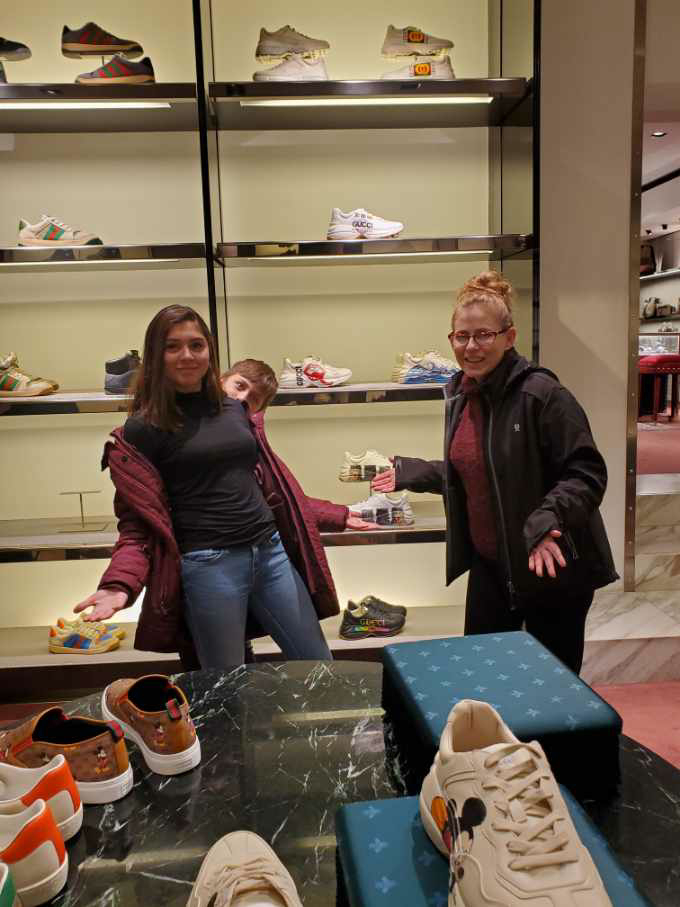

 Travel Tip: You cannot just waltz into a high fashion store in Florence. A doorman will assess the number of people in the store before letting another group in. Be prepared to be told to wait outside. Expect that they may take your bags before letting you walk around, as with the very first Gucci store (say your name...Maddy; listen for them to repeat it...Grazie, Mary...because you will need to recall the name they gave you to retrieve your bag before leaving).
3. Is this shopping district essential to Florence?
The short answer is yes. From the shops on the Ponte Vecchio, to the high fashion brands along the streets, Florence welcomes and celebrates artists of all calibers and if you bring enough monies then Florence has what you are looking for.
Fischer in the Supreme store: "Can I have this red sweatshirt? Please?"
James, looking at the tag: "For 380 Euro, I don't think so."
Fischer, negotiating: "This t-shirt?"
James, looking at the tag: "I am not spending 180 Euro on a t-shirt."
Fischer and Nolan settle on stickers instead.

Surprisingly, in all of Italy so far, there are not many street musicians even though they proudly display three of Stradivarius's violins and cellos in the same museum as where Michelangelo's David can be seen.


 Almost more impressive about the statue of David by Michaelangelo is the unfinished works leading up to David. The way Michaelangelo seemed to be setting these figures free of their marble is truly staggering.
Strictly an Observation: Immigrants Seem to Irritate Mediterraneans
All throughout our travels, the natives freely discuss their position on the effects of immigration in their countries.
 Caption: Real Estate adverts for whom? Possible ex-pats?
For instance, in Greece, James commented on their population being 20 million. The taxi driver promptly said, "We are eleven million, no more. Those others that call themselves Greek but live somewhere else are not Greek to us, they are wherever they immigrated to."
Also in Greece, I asked where the refugees from Syria moved to within Greece and what type of work they do now. The taxi driver said, "No, they are not invited here. They are stealing from us. They are not welcome. When they got into those rafts and set sail with so many of them they would wait to see a coast guard and then slash their rafts so that they would have to be rescued. We are part of EU. Many countries are supposed to take refugees, but did they help us? No. So of course we let them in and nobody helps."
 Caption: Subtle, not so subtle, graffiti.
In Florence, our tour guide told the group that there are so many immigrants there illegally pretending to have permission to sell on the streets but they are not welcome. She warned, "They put their pictures on the floor and narrow the walkways then when tourists accidentally step on them, they say they must now buy them. And the mimes, with the white faces, who take pictures are same time picking pockets. What can we do? I took the police with me and pointed each one out and they got arrested, then next day back on the street. Nothing can be done about the immigrants."

 Caption: Quotes from Dante's Inferno are posted on the walls in one section of Florence.
On every occasion, in each country there is a sense of national pride that supersedes the global handshake that is the socialism they lean on. They seem okay with the part of socialism where idea/invention is shared like community property (although they are behind in technology. For instance, in Greece the commercials advertise i7 processor...James and I both have i8 and the Intel 10th Gen is being advertised in America). They definitely find value in American music and tv/film. Wherever you go in either country there is American music playing. The TVs have several channels with American films dubbed with their language as in the case of Italy, or captioned, as in the case of Greece. And most definitely, all eyes are on American news. But then again, their problems are not with American immigrants.
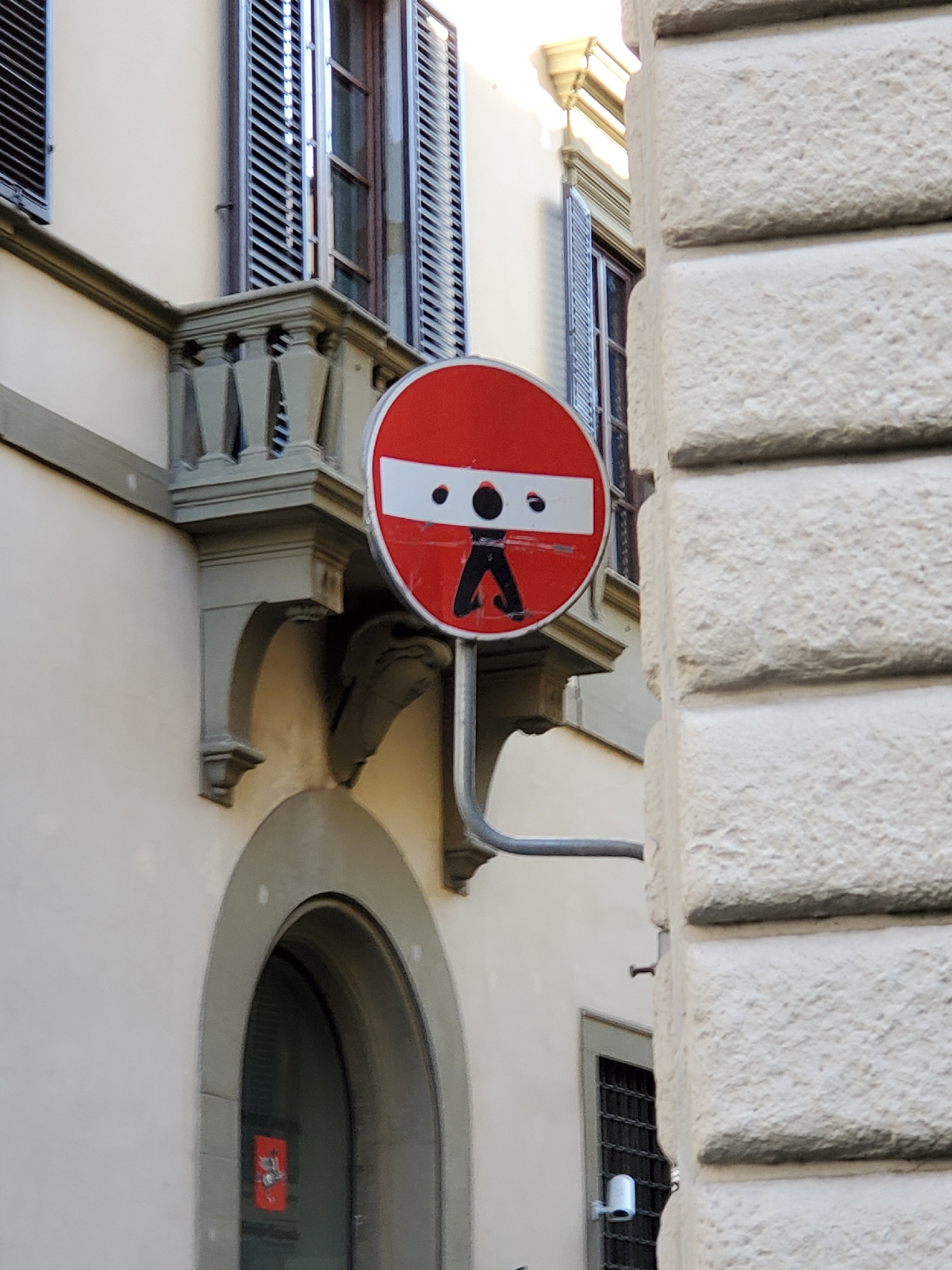 Caption: Subtle, not so subtle, graffiti.
The reason this aversion to immigrants stands out to us so much is because:
1. Greece is the birthplace of democracy.
2. Rome is founded on ancient Greek settlers. Italy has great pride in the architectural influences of Greece, which tour guides never mention, but that we know now that we started at the beginning of time in Athens.
3. Florence prides itself on being the mother of Renaissance who bore so many great inventors, scientists, painters, sculptors, designers, etc. that the world benefits from.
As we continue our travels, it is interesting to compare:
1. ancient societies and architecture to the evolution of these country's modern day societies and architecture, and
Teens are very different types of travellers than little kids. They are regarded as adults who are meant to understand the histories being told on the tours. There is no tiptoeing around them. The guides even talk more to them at times than the adults as in explaining the significance of the statue titled The Rape of the Sabine Women. Our teens are engaged to the full potential of their ages and this has created an environment for conversations that were not shared with us the first time we traveled with them making this trip more meaningful than the first trip.


2. What makes Florence a great place for artists and designers of high end fashion?
Upon arriving in Florence it is hard to recall that Florence and Tuscany bore some of the greatest artists and scientists of all time: Michelangelo, Da Vinci, Brunelleschi, Botticelli...for example. Mostly because those names, at first glance, are overshadowed by relatively newer names: Gucci, Fendi, Louis Vouitton, Prada, Balenciaga, and on and on. It is a fashion mecca no less competitive than the Renaissance era. Florence has a capitalist feel...inspirational, inventive, competitive.
3. Is this shopping district essential to Florence?
The short answer is yes. From the shops on the Ponte Vecchio, to the high fashion brands along the streets, Florence welcomes and celebrates artists of all calibers and if you bring enough monies then Florence has what you are looking for.
Fischer in the Supreme store: "Can I have this red sweatshirt? Please?"
James, looking at the tag: "For 380 Euro, I don't think so."
Fischer, negotiating: "This t-shirt?"
James, looking at the tag: "I am not spending 180 Euro on a t-shirt."
Fischer and Nolan settle on stickers instead.
Surprisingly, in all of Italy so far, there are not many street musicians even though they proudly display three of Stradivarius's violins and cellos in the same museum as where Michelangelo's David can be seen.
Strictly an Observation: Immigrants Seem to Irritate Mediterraneans
All throughout our travels, the natives freely discuss their position on the effects of immigration in their countries.
For instance, in Greece, James commented on their population being 20 million. The taxi driver promptly said, "We are eleven million, no more. Those others that call themselves Greek but live somewhere else are not Greek to us, they are wherever they immigrated to."
Also in Greece, I asked where the refugees from Syria moved to within Greece and what type of work they do now. The taxi driver said, "No, they are not invited here. They are stealing from us. They are not welcome. When they got into those rafts and set sail with so many of them they would wait to see a coast guard and then slash their rafts so that they would have to be rescued. We are part of EU. Many countries are supposed to take refugees, but did they help us? No. So of course we let them in and nobody helps."
In Florence, our tour guide told the group that there are so many immigrants there illegally pretending to have permission to sell on the streets but they are not welcome. She warned, "They put their pictures on the floor and narrow the walkways then when tourists accidentally step on them, they say they must now buy them. And the mimes, with the white faces, who take pictures are same time picking pockets. What can we do? I took the police with me and pointed each one out and they got arrested, then next day back on the street. Nothing can be done about the immigrants."
On every occasion, in each country there is a sense of national pride that supersedes the global handshake that is the socialism they lean on. They seem okay with the part of socialism where idea/invention is shared like community property (although they are behind in technology. For instance, in Greece the commercials advertise i7 processor...James and I both have i8 and the Intel 10th Gen is being advertised in America). They definitely find value in American music and tv/film. Wherever you go in either country there is American music playing. The TVs have several channels with American films dubbed with their language as in the case of Italy, or captioned, as in the case of Greece. And most definitely, all eyes are on American news. But then again, their problems are not with American immigrants.
The reason this aversion to immigrants stands out to us so much is because:
1. Greece is the birthplace of democracy.
2. Rome is founded on ancient Greek settlers. Italy has great pride in the architectural influences of Greece, which tour guides never mention, but that we know now that we started at the beginning of time in Athens.
3. Florence prides itself on being the mother of Renaissance who bore so many great inventors, scientists, painters, sculptors, designers, etc. that the world benefits from.
But we fully understand this irritation the Greeks have about the immigrants to their country. They are struggling to feed and employ their own citizens. They just buckle under the weight of immigrants.
And, Italy is still relatively new as a country and unification has not come easy, so holding onto their identities is understandably very important.
As we continue our travels, it is interesting to compare:
1. ancient societies and architecture to the evolution of these country's modern day societies and architecture, and
2. attitudes between now and three years ago when we took the kids to Europe
Teens are very different types of travellers than little kids. They are regarded as adults who are meant to understand the histories being told on the tours. There is no tiptoeing around them. The guides even talk more to them at times than the adults as in explaining the significance of the statue titled The Rape of the Sabine Women. Our teens are engaged to the full potential of their ages and this has created an environment for conversations that were not shared with us the first time we traveled with them making this trip more meaningful than the first trip.